 Trading Reps
Lesson 21 of 31 · Zero to reading a chart
Relative Volume: "A Lot of Volume" Is Not a Number
"A lot of volume" is a comparison, not a number: measure today's shares against the stock's own twenty-day average and the multiple is the number - a real day at 4.9 times its normal, and a much bigger company whose far larger count was, for it, below normal. Volume is fuel, not direction.
Somebody tells you a stock had a lot of volume today. How much is a lot?

Most people think there is an answer. A big number, over some line, counts as a lot.
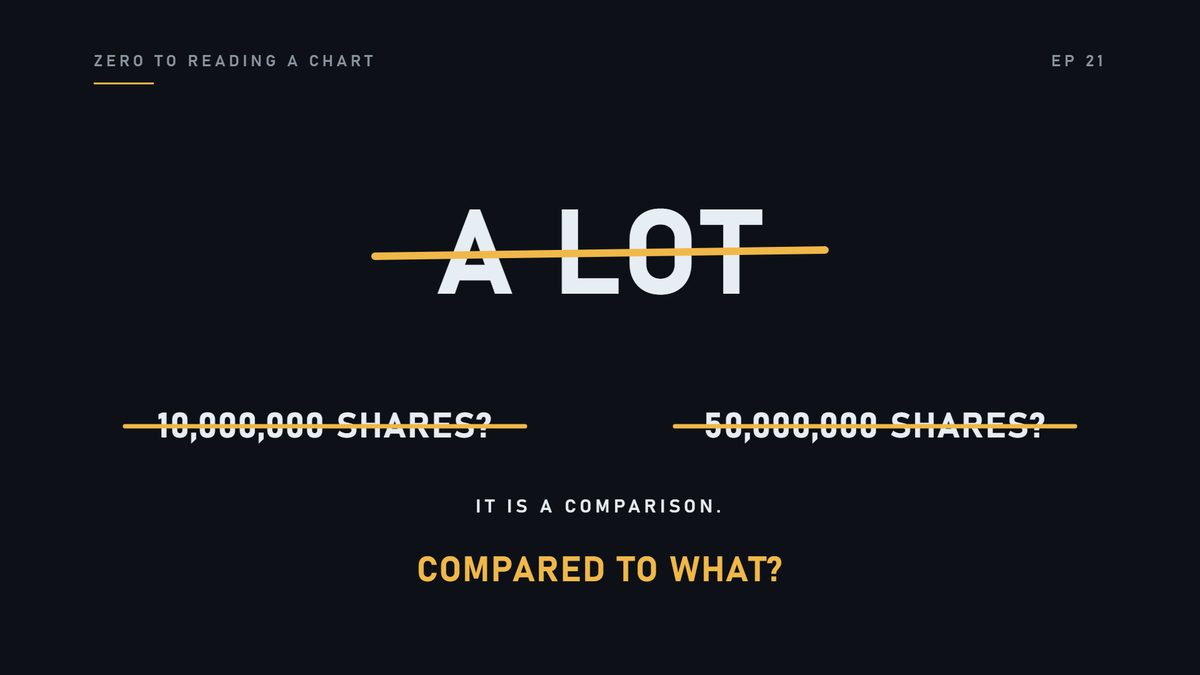
There is no such line. A lot is not a number. It is a comparison. And you have to say: compared to what?
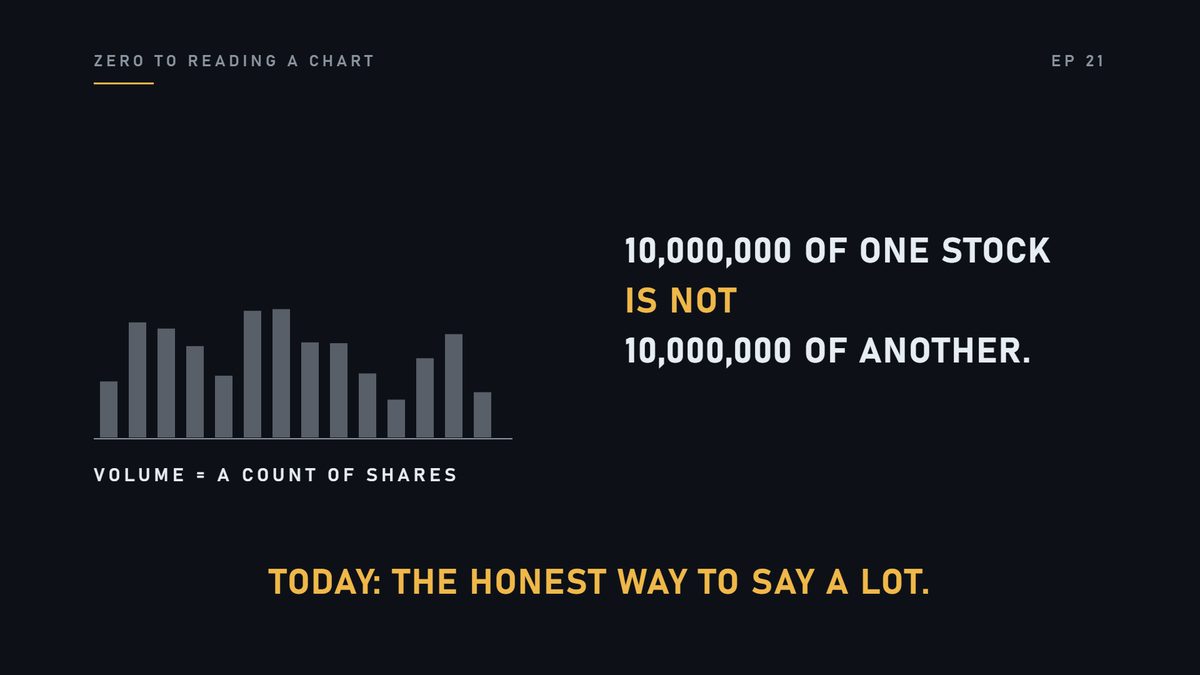
You know volume is a count of shares. And ten million shares of one stock are not ten million of another. Today: the honest way to say a lot.

Think of a quiet street. Ten cars an hour, most days. One morning, fifty cars go past. That is a lot, for that street.
Now think of a motorway. Fifty cars an hour is nothing. It is nearly empty.
Same fifty cars. One is a busy day, and one is a dead one.
So a lot only means something next to normal. And normal is different for every stock.
Big companies trade huge numbers of shares on a boring day. Small companies never reach that on their busiest day.
So here is how to measure it. Take the last twenty trading days. Add up the shares traded on each one.
Divide by twenty. That is this stock's normal: its twenty-day average.
Now take today's bar and ask: how many times normal is it? Once? Twice? Five times?
Compare today to the stock's own normal, and a lot becomes a number. Five times normal is a number. A lot is not.
Here is the real thing. A daily chart, with the row underneath.
This line running across the bars is the twenty-day average. Normal, for this stock. Most days sit near it.
And this day. Its bar towers over the line. Four point nine times normal. That is what a lot looks like when you measure it.
Now here is a very big company on an ordinary day.
Look at the raw number of shares. Far more than the first stock traded on its big day.
Now look at its bar against its own line. At normal. Below it, even.
By the count, this is the busier stock. Compared to its own normal, nothing happened here at all.
Measure a stock's volume against that stock's own twenty-day normal. The multiple is the number. The raw count is not.
Here is the mistake. Somebody picks a fixed number, say ten million shares. They look for stocks above it.
They get a list of the biggest companies, every day, doing nothing unusual. They chose a number. The stock did not.
And one more thing. Five times normal tells you many more shares moved than usual. It does not tell you which way the price goes next.
Volume is the size of the crowd. It is fuel. It is not a direction.
Find the average line under any chart. Ask how many times normal today is.
Remember this. Measure a stock's volume against its own normal, not against a number you chose.
Check yourself
- "A lot of volume" - compared to what?
- That stock's own twenty-day normal.
- What does "three times" mean?
- Three times the stock's own average day.
- Does volume tell you direction?
- No. It is fuel, not direction.
Next lesson: Premarket Volume: One Number Worth Reading.
For learning only. Not financial advice, not signals, not stock picks.